
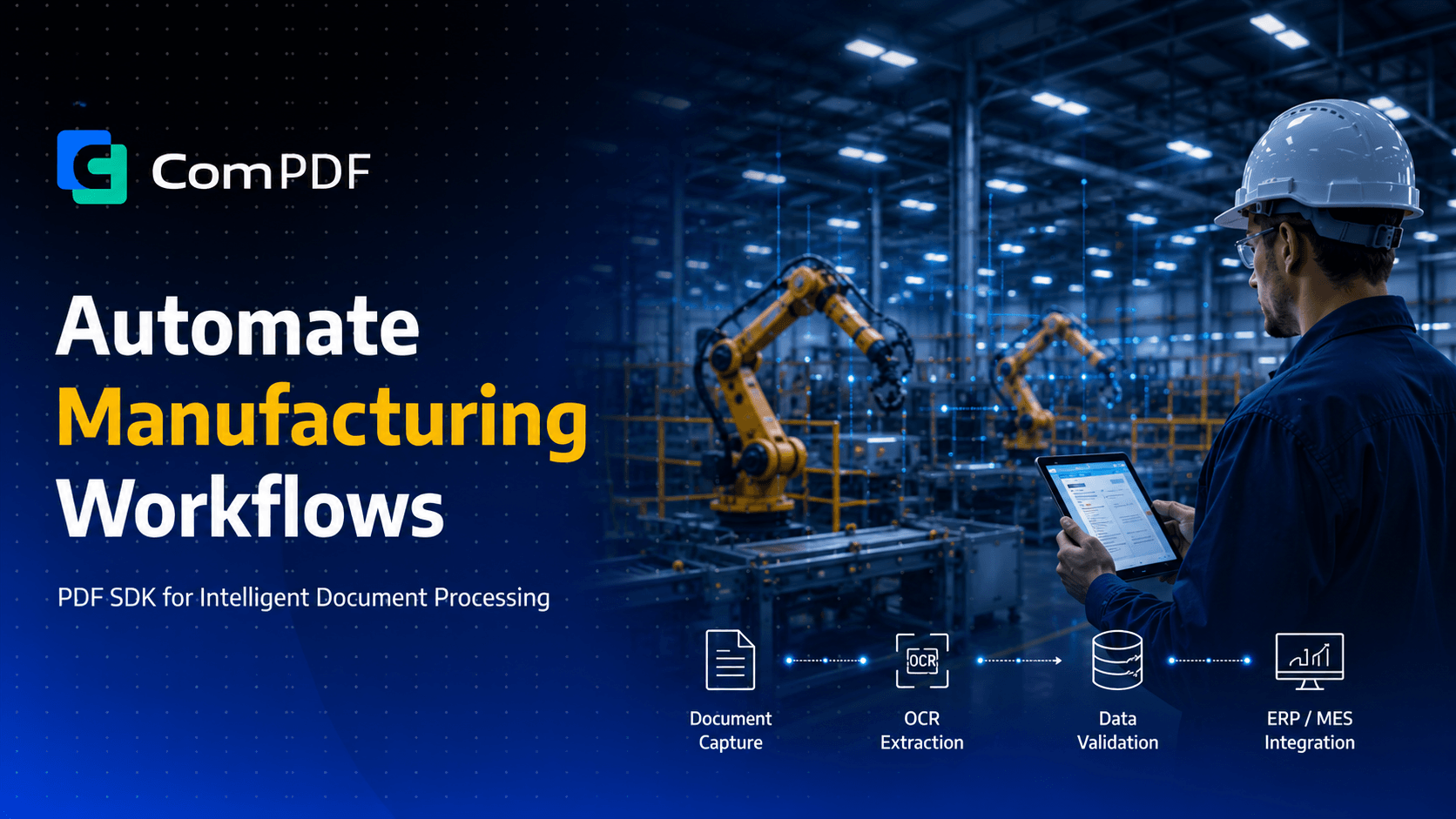
Manufacturing organizations have invested heavily in ERP, MES, and PLM systems, yet document processing remains a common source of delay. In many teams, data still moves through PDF exports, manual edits, re-entry into business systems, and fragmented approval flows. This creates a gap between digital infrastructure and day-to-day execution.
This article provides a practical framework for closing that gap with PDF SDK capabilities integrated into existing systems. For teams evaluating solution scope, the official Manufacturing DX Solutions page can be used as a reference for product fit and deployment discussion.
Why Document Workflows Become a Bottleneck
Most manufacturing teams do not face a single system problem. They face a workflow continuity problem.
- Quality records generated in MES, then manually reformatted for internal review or external submission.
- Supplier invoices and certificates received as mixed-format PDFs, then manually extracted into ERP.
- Engineering files exported from PLM without consistent post-processing for access control or distribution policy.
- Compliance archives prepared at period end through repetitive manual consolidation.
These issues increase handling time and introduce avoidable inconsistency. They also reduce process visibility because document steps are difficult to monitor when handled outside core systems.
Where PDF SDK Integration Adds Operational Value
In manufacturing environments, PDF capability should be treated as an infrastructure function, not only a viewing feature. The integration objective is to standardize four process layers:
- Document generation from structured system events.
- Data extraction from unstructured or semi-structured documents.
- Security and policy controls before internal or external sharing.
- Conversion and packaging for downstream workflows or archive requirements.
Teams also comparing replacement strategy can review the SDK Migration and Comparision page in parallel with manufacturing-specific requirements.
Priority Use Cases for Phased Implementation
1. Quality and Production Report Standardization
Automatically generate inspection reports, test summaries, or production records from MES data using predefined templates and naming conventions.
- Reduced report preparation effort.
- Better output consistency across teams and plants.
- Improved audit retrieval readiness.
2. Supplier Document Intake and Field Extraction
Apply OCR and extraction logic to incoming PDFs such as invoices, certificates, and delivery paperwork, then map key fields into ERP records.
- Lower manual re-entry workload.
- Fewer transcription errors.
- Faster document-to-posting cycle.
3. Controlled Engineering Document Distribution
Before sharing drawings and technical files outside engineering teams, apply policy controls such as permissions, watermarking, and signature workflows.
- Stronger protection of controlled documents.
- More consistent handling of distribution rules.
- Better traceability for compliance review.
Practical Evaluation Framework Before Production Rollout
A technical feature checklist alone is not enough. Evaluation should combine system fit, policy fit, and operational fit.
| Dimension | What to Validate |
|---|---|
| Integration path | Compatibility with existing ERP, MES, and PLM interfaces. |
| Deployment model | Support for cloud, embedded, or self-hosted options aligned with infrastructure policy. |
| Security baseline | Encryption, signature handling, and permission controls. |
| File quality performance | Extraction and conversion accuracy on real production files. |
| Support readiness | Documentation quality and implementation response efficiency. |
PoC Design: Small Scope, Measurable Outcomes
A practical PoC usually includes two or three workflows selected by volume and business impact:
- One outbound flow, such as MES-based quality report generation.
- One inbound flow, such as supplier PDF extraction into ERP.
- One controlled distribution flow, such as PLM document security processing.
Define baseline and target metrics for cycle time, manual touchpoints, extraction accuracy, exception ratio, and audit preparation effort. Keep success criteria explicit before execution.
Conclusion
Manufacturing document automation is most effective when positioned as part of integration architecture, not as an isolated productivity tool. By embedding PDF SDK capabilities into ERP, MES, and PLM workflows, organizations can improve document consistency, reduce manual dependency, and strengthen compliance execution in measurable ways.
A focused PoC with explicit KPI design remains the safest path to decision-quality evidence. Once one workflow proves stable in production conditions, expansion to additional business processes becomes significantly more predictable.
For teams preparing an evaluation plan, the Manufacturing DX Solutions provides a practical starting point for scope alignment and implementation discussion.